

The Research & Development team at Gandalf Project presents an advanced model for volatility forecasting, designed to offer strategic insights into the evolving risk dynamics of major S&P 500 stocks.
Based on proprietary algorithms that integrate cutting-edge machine learning techniques, the model estimates the likelihood of each asset falling into one of five volatility classes. This approach enables traders and portfolio managers to refine their strategies and optimize their risk/return profile.
Particularly well-suited for applications in asset management, the model incorporates predictive signals derived from the joint analysis of price and volume structures, macroeconomic variables, options’ implied volatility, and alternative data sources.
Forecasting Methodology
Our prediction engine classifies stocks into five distinct volatility categories:
- Very Low Volatility (Class 0) – Stable assets with minimal price fluctuations.
- Low Volatility (Class 1) – Assets with moderate swings, ideal for conservative strategies.
- Normal Volatility (Class 2) – Balanced risk/return profiles.
- High Volatility (Class 3) – Increased price activity, suitable for active trading.
- Very High Volatility (Class 4) – Rapid price changes, with high-risk/high-reward opportunities.
Each stock is assigned a predicted class along with a full probability distribution across all categories. The argmax metric represents the highest confidence level for the predicted classification, serving as an indicator of reliability.
An example of forecasted probability distributions is shown below (for detailed predictions, please contact info@gandalfproject.com):
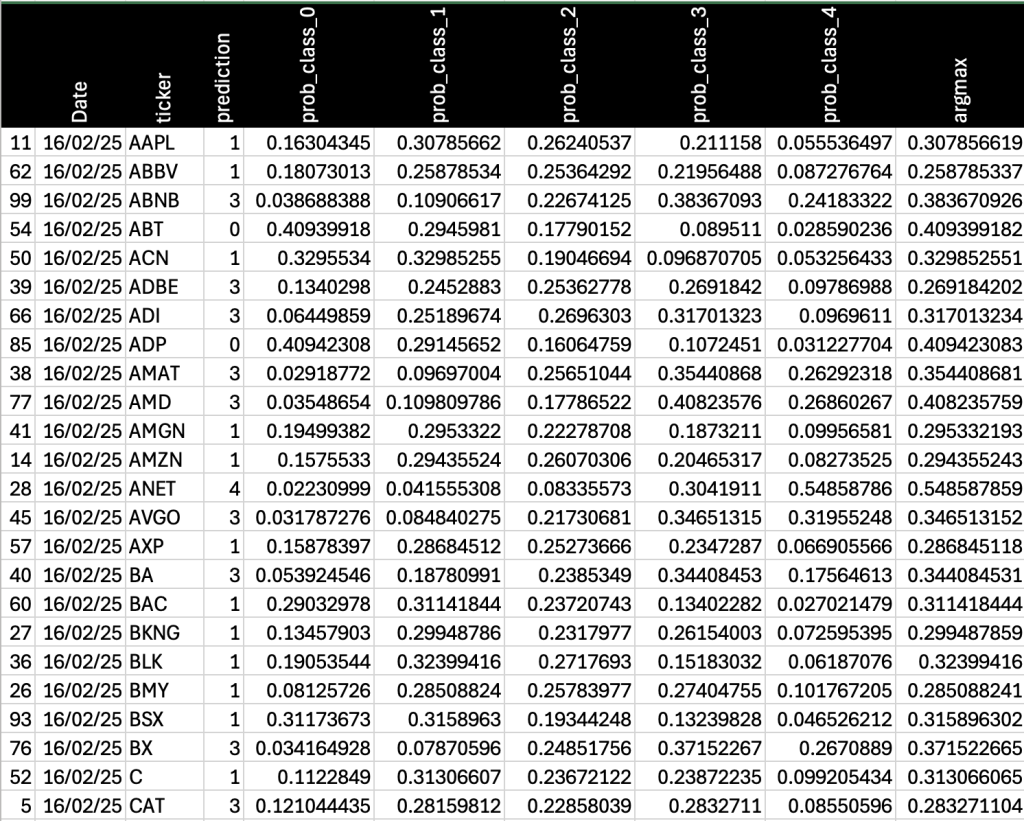
Weekly Volatility Forecast – S&P 500 (March 24–28, 2025)
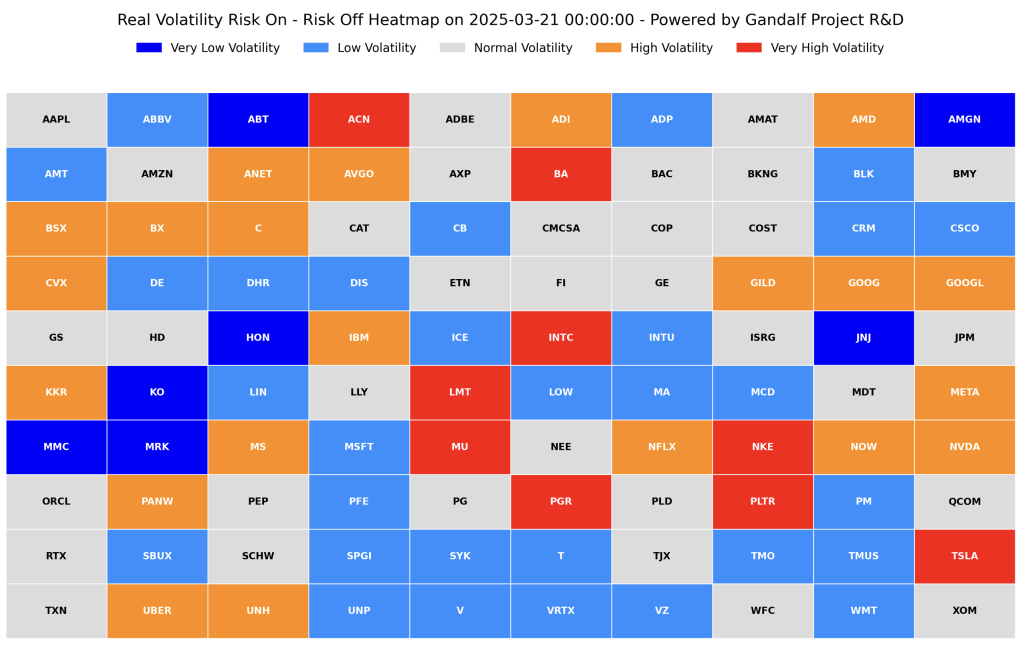
Current Volatility Snapshot – March 21, 2025
We begin with the actual volatility status measured at the close of markets on Friday, March 21, 2025:
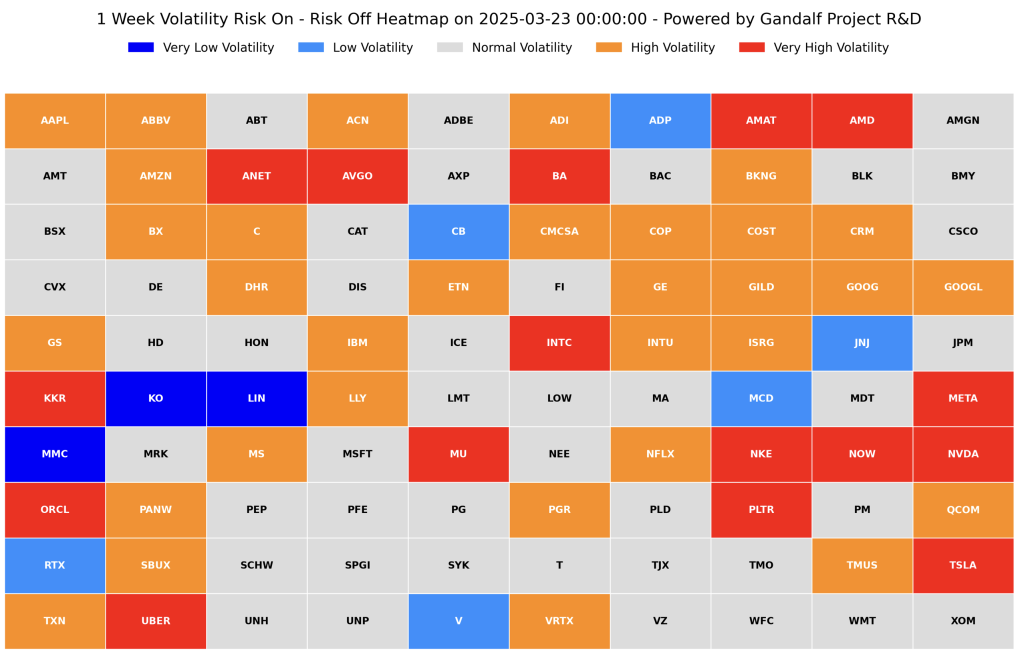
Forecast for the Coming Week
Below is the model’s forecast for the following trading week:
General Outlook: Volatility Distribution for Week 13
The weekly forecasts generated by our machine learning models suggest growing market pressure, with a significant shift towards higher risk classes.
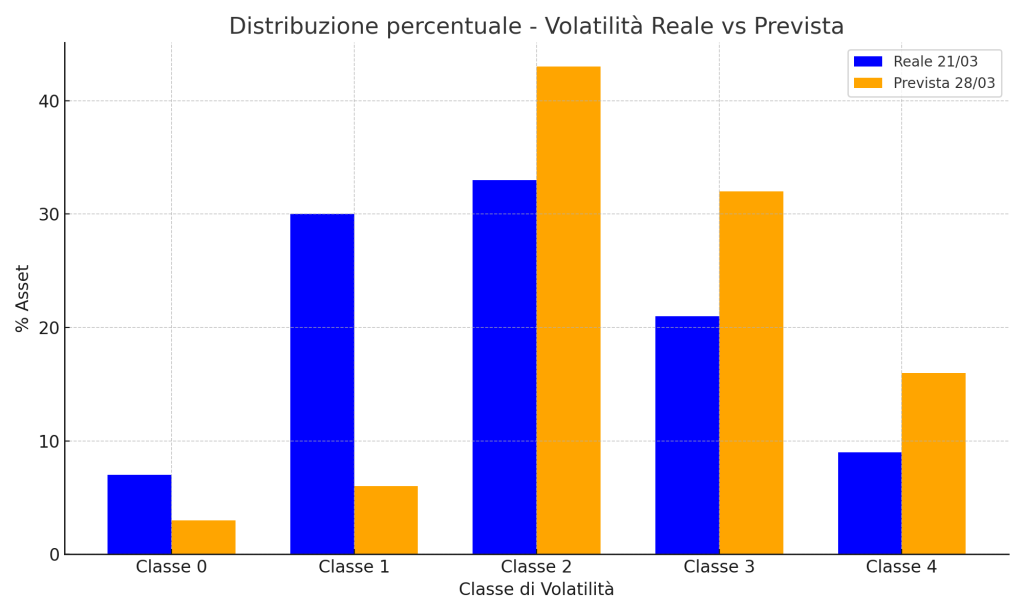
Compared to the current state, the share of assets in Classes 3 and 4 increases from 30% to 48%. This points to a likely transition into a higher volatility regime for the upcoming week.
Detailed Overview of Significant Volatility Changes
Below are the stocks expected to experience a significant change (≥ 2 classes) in weekly volatility compared to current levels:
• AMGN (Amgen): forecast rises from class 0 to class 2 (↑ 2 levels).
• ABBV (AbbVie): forecast rises from class 1 to class 3 (↑ 2 levels).
• VRTX (Vertex Pharmaceuticals): forecast rises from class 1 to class 3 (↑ 2 levels).
• ORCL (Oracle): forecast rises from class 2 to class 4 (↑ 2 levels).
• ABT (Abbott Laboratories): forecast rises from class 0 to class 2 (↑ 2 levels).
• MRK (Merck & Co.): forecast rises from class 0 to class 2 (↑ 2 levels).
• DHR (Danaher Corporation): forecast rises from class 1 to class 3 (↑ 2 levels).
• LMT (Lockheed Martin): forecast drops from class 4 to class 2 (↓ 2 levels).
• SBUX (Starbucks): forecast rises from class 1 to class 3 (↑ 2 levels).
• HON (Honeywell): forecast rises from class 0 to class 2 (↑ 2 levels).
• AMAT (Applied Materials): forecast rises from class 2 to class 4 (↑ 2 levels).
• TMUS (T-Mobile US): forecast rises from class 1 to class 3 (↑ 2 levels).
• INTU (Intuit): forecast rises from class 1 to class 3 (↑ 2 levels).
• CRM (Salesforce): forecast rises from class 1 to class 3 (↑ 2 levels).
Application in Trading and Risk Management
The Gandalf Volatility Forecaster enables market participants to:
• Adjust Portfolio Risk: Rebalance exposure based on projected volatility regimes.
• Enhance Hedging Strategies: Identify stocks that may require protective positions.
• Improve Alpha Generation: Focus on high-volatility assets for momentum-oriented strategies.
The Service
For more information about our corporate service, please contact:
📧 info@gandalfproject.com
Have a great week,
Gandalf Project R&D Team
Disclaimer
The information contained in this report is provided for educational and informational purposes only. It does not constitute a solicitation to the public for savings, investment advice, or an offer to buy or sell any financial instruments.
The publisher (Gandalf Project) assumes no responsibility for any investment decisions made based on the contents of this document. Investors are encouraged to conduct their own due diligence and, if necessary, consult a qualified financial advisor before taking any investment-related actions.
