

We fed all our weekly data, obtained using proprietary algorithms, into a Generative AI and asked it to provide us with some useful insights. Here’s how it went!
Analysis of Volatility Shifts: March 14, 2025 vs. March 21, 2025 – Week 12
The following picture shows the previous volatility forecast for the period from March 10th to March 14th (for further details, please refer to the previous article “Gandalf Volatility Forecaster: A Cutting-Edge Approach to S&P 500 Volatility Prediction“).
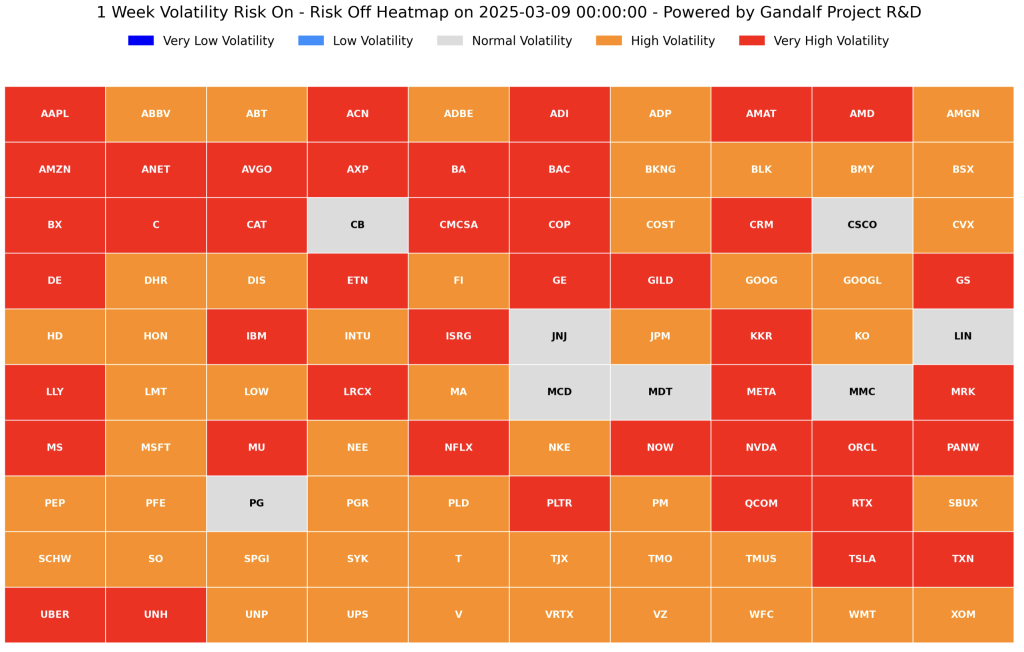
The next one represents the actual volatility observed on March 14th, 2025, serving as a starting point for the next prediction. A total of 47 assets were correctly predicted, while only a few showed a difference of more than one class!
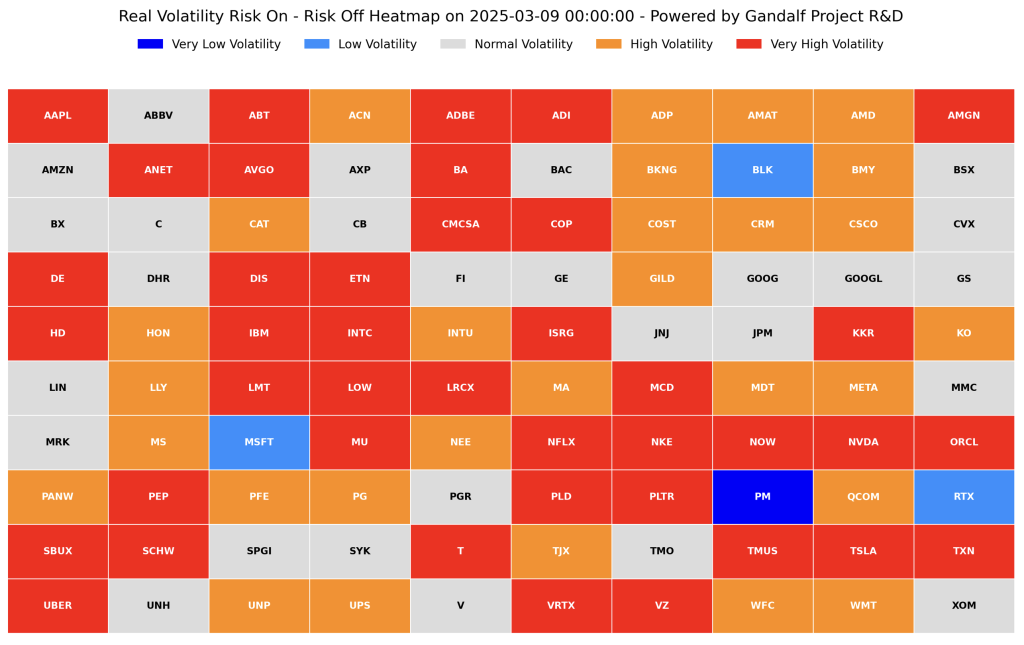
The last table shows the forecast for the next week, from Monday the 17th to Friday the 21st.
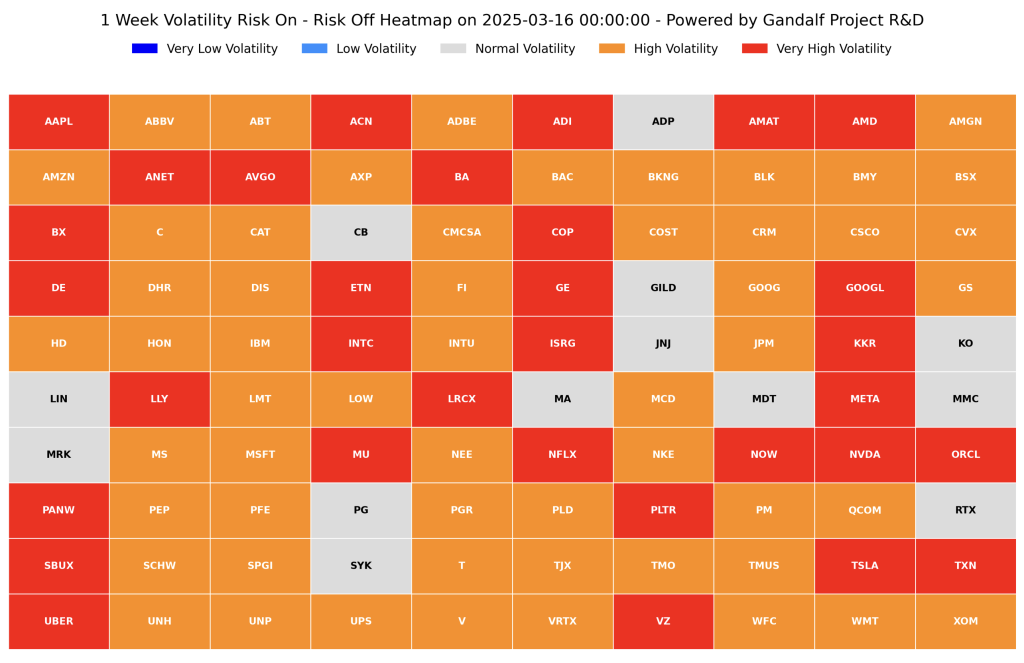
Summary of General Volatility Predictions
The volatility predictions for March 21, 2025, show significant shifts compared to the real volatility observed on March 14, 2025. The overall market trend suggests an increase in high-volatility classifications, with some previously stable stocks experiencing sharp jumps in expected market turbulence. Notably, stocks that were classified as “Normal” or “Low Volatility” on March 9 are now moving toward “High Volatility” or even “Very High Volatility.”
This shift implies increased market uncertainty, potentially driven by external macroeconomic events or sector-specific risks. The highest concentration of “Very High Volatility” stocks remains in the technology and financial sectors, while some industrials and consumer discretionary stocks have also seen increased risk levels.
Most Varied Stocks
A detailed analysis of the largest changes in volatility classification highlights several key stocks that experienced substantial shifts:
- Philip Morris International (PM)
- Previous Volatility: Very Low Volatility
- Predicted Volatility: High Volatility
- Change: +3 levels
- Analysis: This sharp increase suggests market expectations of upcoming uncertainty surrounding the stock. This could be driven by earnings reports, regulatory developments, or sector-wide concerns.
- Microsoft (MSFT)
- Previous Volatility: Low Volatility
- Predicted Volatility: High Volatility
- Change: +2 levels
- Analysis: Microsoft has moved from a relatively stable state into a significantly more volatile forecast. This may reflect increasing investor uncertainty around AI investments, quarterly performance expectations, or general tech market movements.
- AbbVie (ABBV)
- Previous Volatility: Normal Volatility
- Predicted Volatility: High Volatility
- Change: +1 level
- Analysis: Pharmaceutical stocks often fluctuate based on trial results or regulatory updates. The shift in AbbVie’s volatility forecast suggests the possibility of market-moving news in the near term.
- Abbott Laboratories (ABT)
- Previous Volatility: Very High Volatility
- Predicted Volatility: High Volatility
- Change: -1 level (decrease)
- Analysis: While most stocks are experiencing increased volatility, Abbott’s slight decline may indicate a stabilization following prior uncertainty.
- Accenture (ACN)
- Previous Volatility: High Volatility
- Predicted Volatility: Very High Volatility
- Change: +1 level
- Analysis: The rising volatility suggests that investors expect greater price swings in Accenture, possibly linked to market-wide concerns about consulting and enterprise spending.
Key Takeaways
- The market is trending toward higher volatility, particularly in large-cap tech and financial stocks.
- PM and MSFT show the most dramatic jumps, with PM experiencing a three-level volatility increase.
- A few stocks, such as Abbott Laboratories, are stabilizing slightly, but this is not the predominant trend.
- Risk management strategies may need adjustment for traders and portfolio managers exposed to these assets.
This shift underscores the importance of monitoring volatility trends to anticipate potential market moves and adjust strategies accordingly. As we approach March 21, 2025, the forecasted volatility should be tracked against actual price movements to assess the accuracy of the models and refine trading or risk-mitigation strategies.
The Gandalf Volatility Forecasting system is an essential tool for financial professionals seeking to stay ahead in today’s dynamic markets. By leveraging cutting-edge AI-driven predictions and excess probability analysis, traders and investors can execute informed decisions with confidence.
For further details and premium access to our full volatility predictions (including the probability table), contact Gandalf Project R&D today at info@gandalfproject.com and provide your email.
Have a great week!
Gandalf Project R&D Team
Disclaimer
The information contained in this report is provided exclusively for educational and informational purposes. It does not in any way constitute a solicitation to the public for savings, an investment recommendation, or an offer to buy or sell financial instruments.
The issuer (Gandalf Project) assumes no responsibility for any investment decisions made based on the information contained in this document. Investors are encouraged to make their own assessments and, if necessary, consult a qualified financial advisor before undertaking any investment-related actions.
The issuer disclaims all liability for any losses or damages resulting from the improper use or interpretation of the information provided herein.
